
How a postal map grows without a plan
One school prints its first paper. The class sends a copy to a teacher they have heard of, in a town they have never visited. That teacher shows it to a class. The class prints a reply. Two nodes, one connection.
What grew from that single gesture — repeated across France, then across borders — was not a designed system. There was no registry, no head office issuing contact lists. The map of correspondences expanded the way a rumour does: by introduction. A school in the Var writes to a school in the Finistère; the Finistère class mentions it to a school in Belgium they already know; Belgium passes the address to a class in Switzerland. Each new connection was the product of a previous one, and the whole structure was held together by paper, ink and the post office.

Célestin Freinet understood this early. The movement he seeded from the 1920s onward depended not on hierarchy but on lateral flow — teacher to teacher, class to class, each pair of correspondents working out the terms of exchange themselves. Distance mattered: a school fifty kilometres away shared too much context to be useful. The whole point was a reader who did not know your village, your weather, your local saint's day — someone for whom nothing could be assumed and everything had to be written plainly.
Finding that reader was a social problem as much as a pedagogical one. New schools entered the network because a known teacher vouched for them, shared an address, passed on what came back from their own exchange as evidence that correspondence was worth the ink. The practical proof of the network's value was the packet that arrived in the classroom: a real printed paper, smelling faintly of ink, produced by children who would never be met.
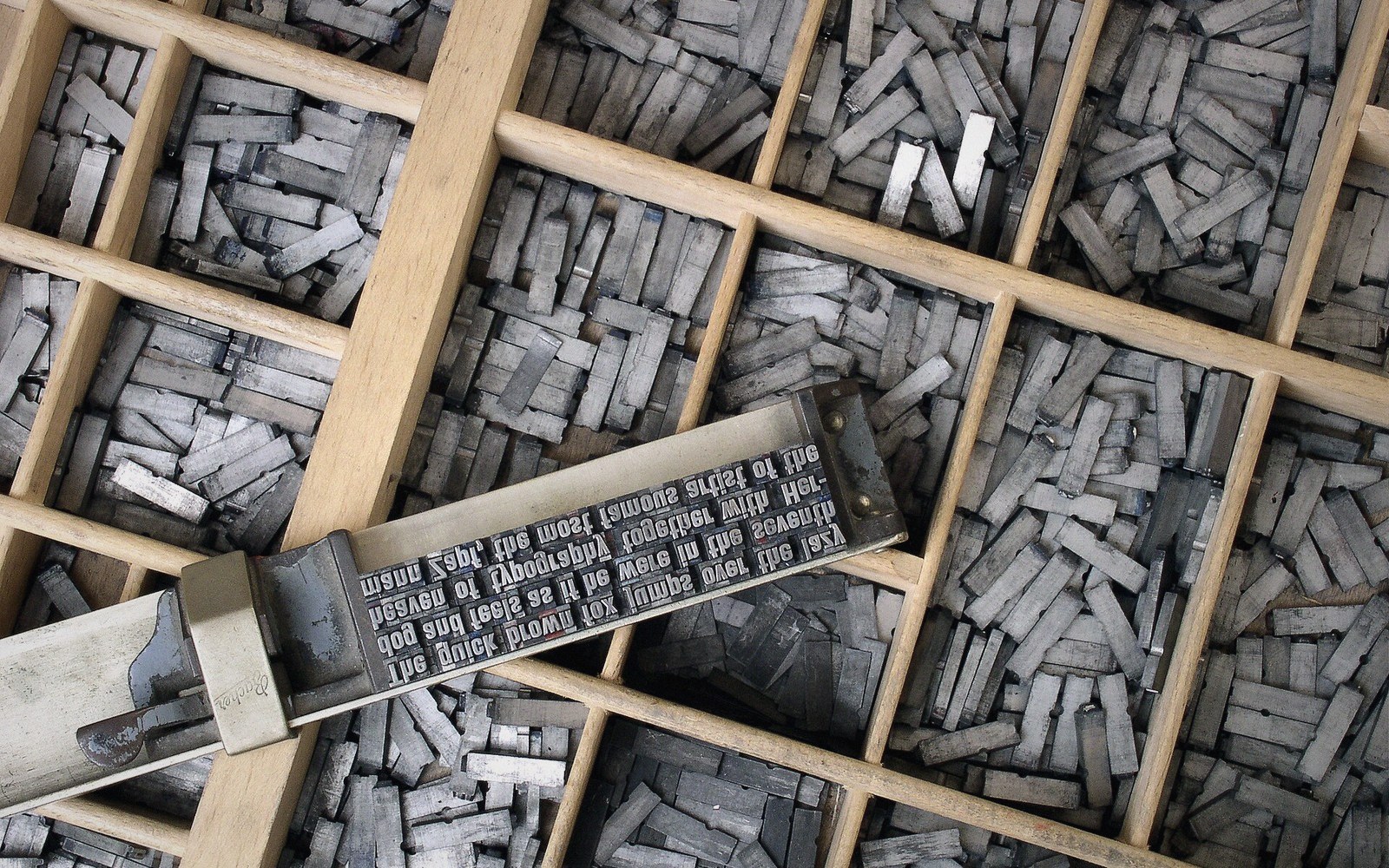
Compartment size follows letter frequency, so the case is a frequency table you can put your hand into.
Photo: Metal movable type · Wikimedia CommonsBy mid-century the network was large enough that some coordination existed — journals circulated addresses of schools seeking correspondents — but the underlying logic never changed. The introduction was still the mechanism. A teacher who moved to a new school brought connections with them. A class that dissolved at the year's end left its correspondent waiting, until someone thought to forward an address.
The network had no centre. It had only edges — each one made by two teachers choosing, independently, to trust the post.