A machine sized to its operator
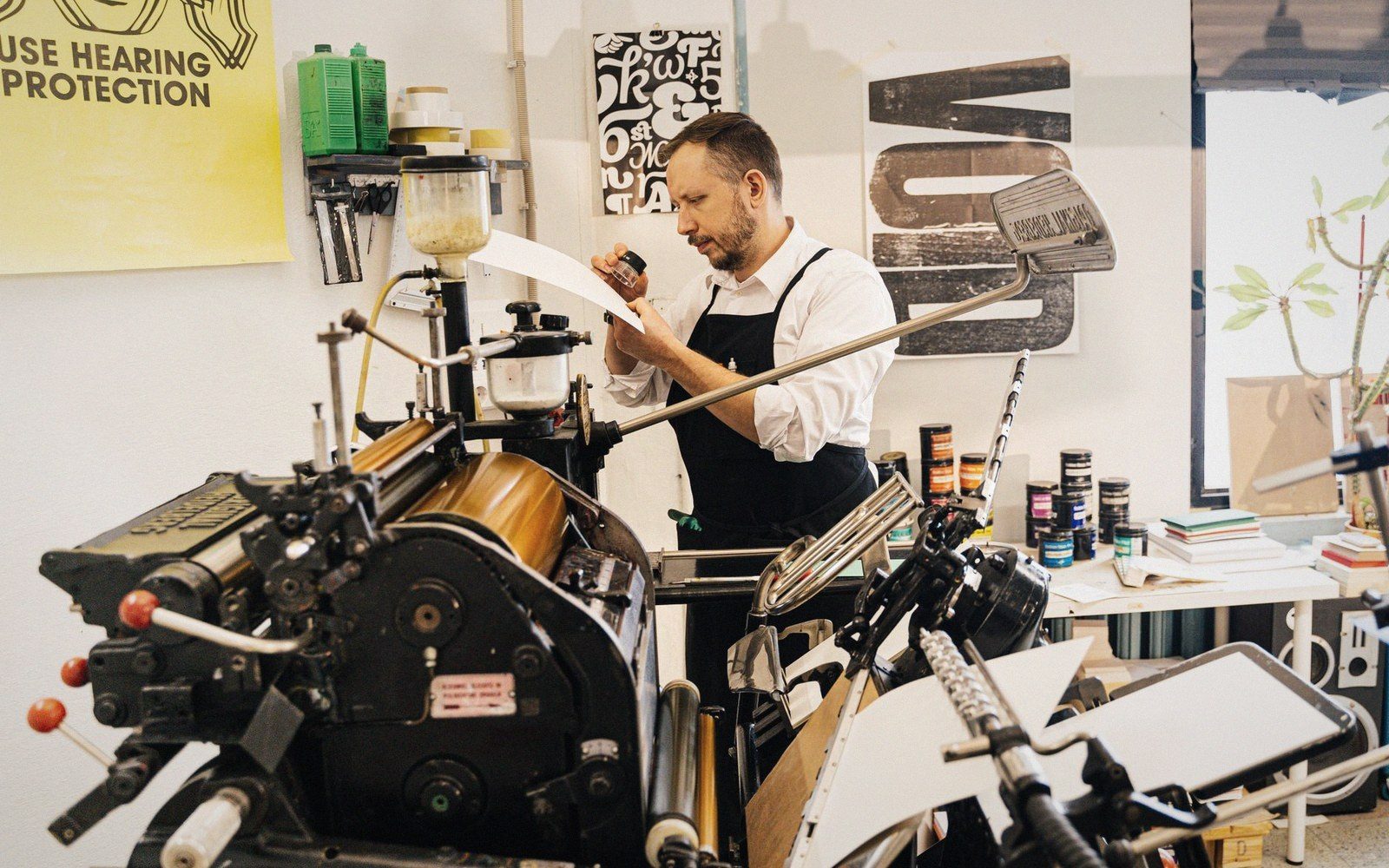
The press that sat at the back of the classroom was not a reduced version of a commercial press. It was a different object entirely — sized from the start around the dimensions of a child working alone, and that single constraint shaped everything downstream: the paper it could print, the run a class could sustain, and the rhythm that organised an afternoon's work.
The typical classroom flatbed of the mid-twentieth century was a small cast-iron machine, bench-mounted and hand-operated. The platen — the flat plate that descended to meet the type — was sized to accept a forme no larger than roughly A5, sometimes a little more, occasionally a little less depending on manufacture and vintage. That was not a compromise. It was the point. A sheet a child could handle without fumbling, a forme a child could ink without losing the roller off the edge, a pull a child could make cleanly without the mechanical advantage of a long-armed proof press.
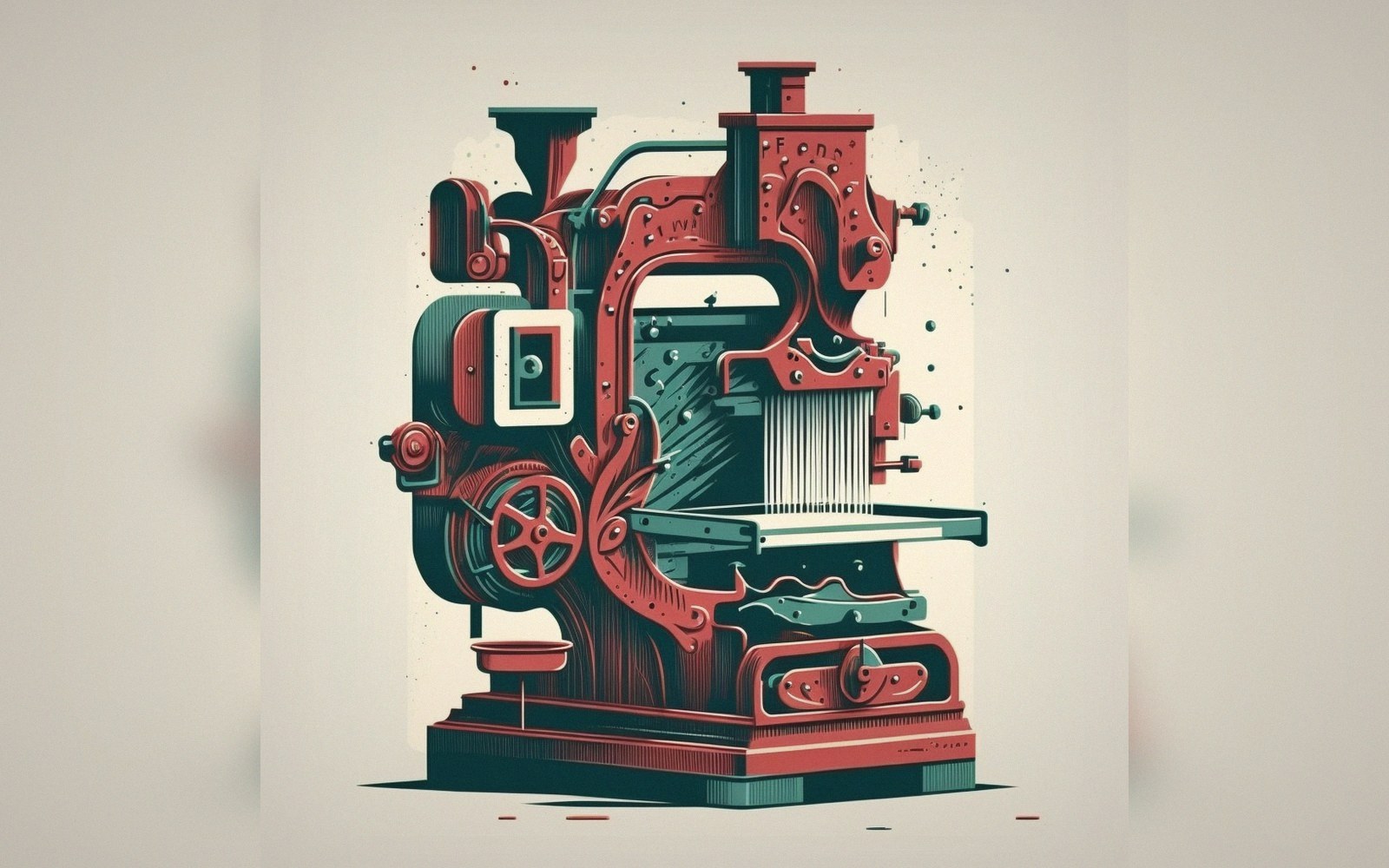
The platen is the whole specification: a forme no larger than it will close on, and a sheet no larger than the forme.
Photo: Gr.Diana letterpress machine · Wikimedia CommonsThe design came out of a tradition already well established in the manual education movement of the late nineteenth and early twentieth centuries. Small iron presses had existed for amateur and educational use since at least the 1880s — the kind sold in parts catalogues alongside woodworking tools and chemistry sets. What changed in the 1920s and 1930s, particularly in France under the influence of Célestin Freinet, was the pedagogical intent. Freinet recognised that a press small enough for a child to operate without an adult intermediary was not merely convenient — it was politically necessary. The point was that the child published; the adult did not publish on the child's behalf. The machine had to make that possible physically, or the pedagogy collapsed.
What the size decided
Sheet size followed from the platen, and from the sheet came every other constraint in the chain. If the press printed to roughly A5, then the school paper was A5, or a folded A4 yielding four small pages, or two A5 sheets stapled at the spine. The format was not a design decision made in the abstract; it was the first consequence of the press's throat. Editors of these papers — which is to say, the class — learned to think within that rectangle as if it were fixed law, because it was.
Run length was the next constraint the press imposed, and here the machine acted not through its size but through its tempo. A small hand press, properly inked and operated, could produce somewhere in the range of a hundred impressions an hour under good conditions — less with a new operator, less again if the inking was being learned at the same time as the pulling. A class edition with a print run of fifty or sixty copies was achievable in a single session. A run of two hundred was a serious undertaking. The press did not forbid ambition, but it priced it in time, and a class quickly learned to match its ambitions to its afternoon.
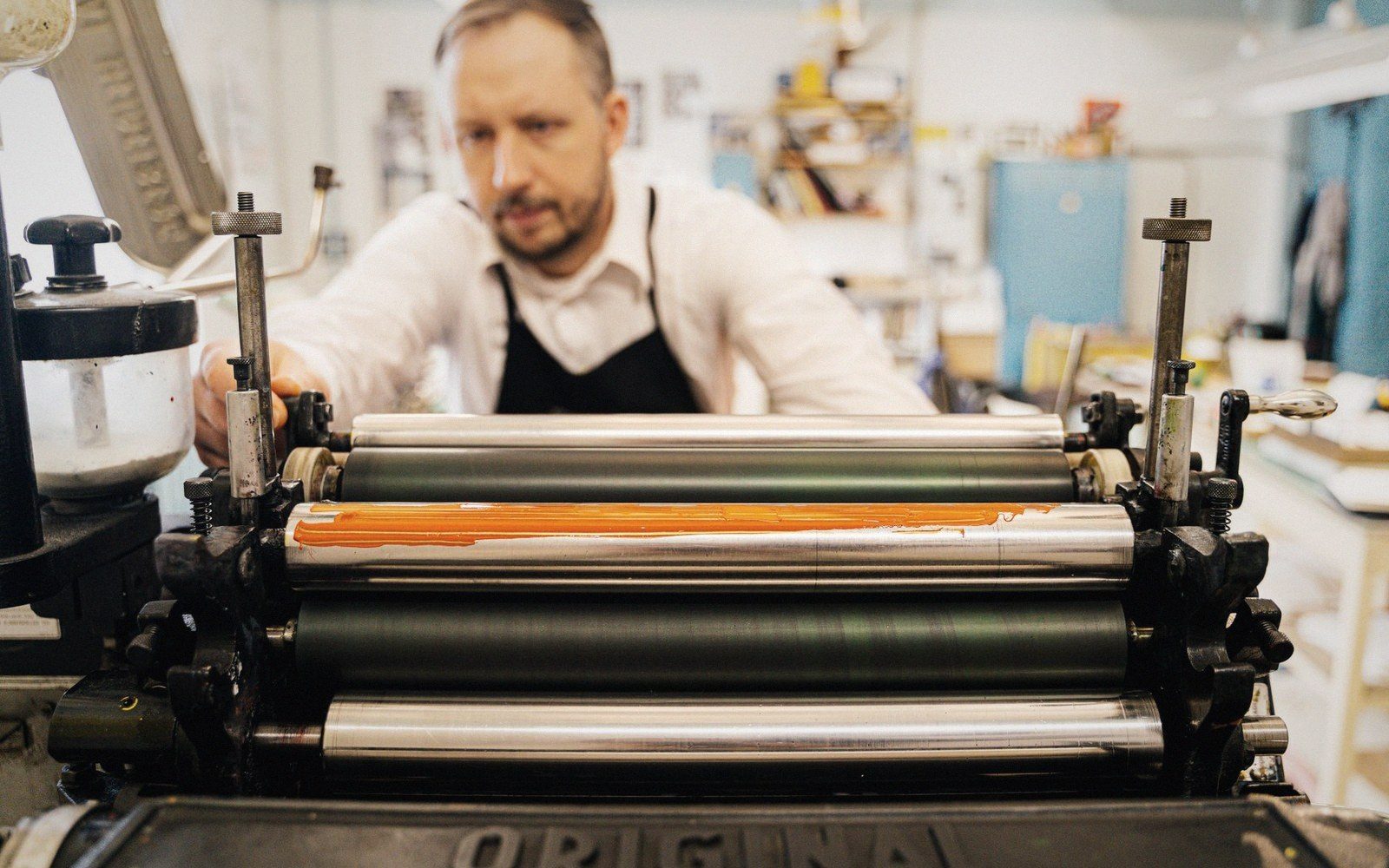
Inking was the step most dependent on practice and least forgiving of inattention. Inking by roller on a small press meant distributing ink across the distribution roller, running it over the type forme evenly, and doing this consistently for every impression in the run. Too much ink and the counters — the enclosed spaces inside letters like e and o — filled and clogged. Too little and the impression was pale and uneven. A child who could hold that band steady over fifty sheets had learned something real about attention and material behaviour, and the press gave immediate feedback that no worksheet could replicate.
The pull itself — the moment of impression — was the most legible part of the operation to a bystander, the one that looked like printing. But it was also the most physically calibrated act in the sequence. Packing — the layers of paper, card or tympan sheet beneath the platen — determined how much pressure the type received. Too little and the ink sat on the surface of the stock without transferring cleanly. Too much and the type bit into the paper with an embossed quality that might look dramatic but wore the face of the type faster than steady use should. A class press was not reconditioned often. Its type was a shared resource that had to last, and the right pressure was one of the things an older student passed to a newer one.
How many hands one edition needed
The operation divided naturally into stations, and the number of hands a single edition needed depended on how the class organised itself rather than on any requirement of the press. One child could do everything: compose, lock the forme, ink, pull, and stack — but that child would be at the press for a long time, and the run would be slow. In practice, a small team of two or three moved faster and with fewer errors. One held the rhythm of inking and laying the sheet; another lifted and jogged the printed sheets into a neat stack for drying; a third could be composing the next section of text while the current forme was still on the press.
This division was informal rather than industrial — there was no foreman, no bell, no fixed rotation. It emerged from the work itself, from the visible bottlenecks that appear when one step runs faster than another. Sheets accumulate when no one is jogging them. The ink gets tacky on the roller if the puller pauses too long. The press, sitting at the back of the room, was not merely a piece of equipment; it was a social technology that made the consequences of cooperation and inattention equally visible.
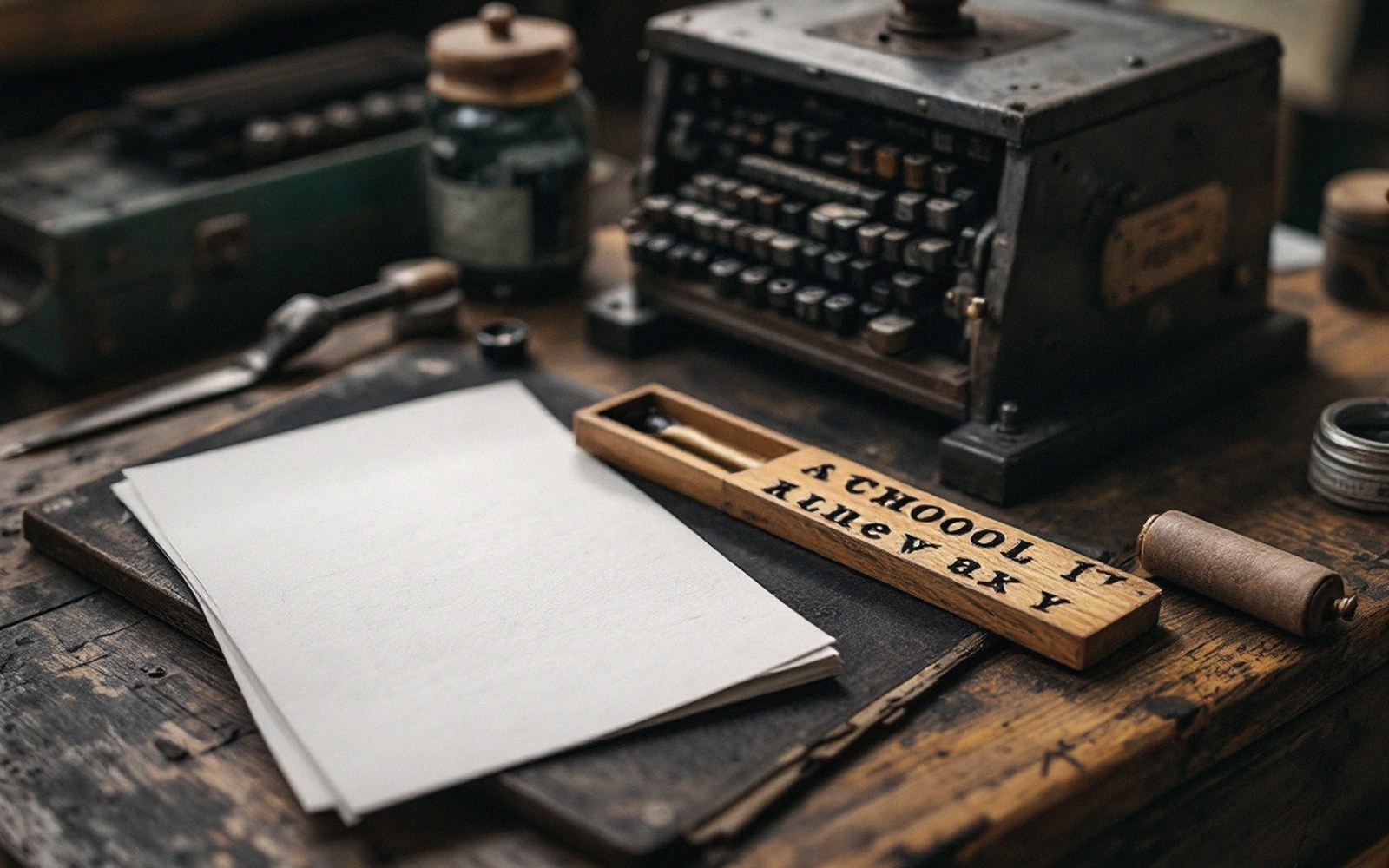
Plate 04. Heavy ink fills the counters of e and o first, which is why a pale proof is the safer error.
Distribution — returning the type to the case after the run — was a separate session, usually deferred until the press work was complete and the sheets were drying on their line. It was slower than composition and less satisfying, and it required a different quality of concentration: not the rhythmic focus of the press run, but the patient discrimination of identifying each character and returning it to its correct compartment in the case. A misplaced letter caused a problem not now but in three weeks, when someone reached for a character that had been wrongly filed. The press imposed its discipline not just on the afternoon of printing but on the afternoon three weeks later when the type was next needed.
A small cast-iron press, bolted to a bench in the corner of a classroom, is not a toy and was never intended as one. It is a real machine that prints real ink on real paper, with a forme set by the children who will read the result. The constraint that made it teachable — its size, its tempo, its capacity for the human error it also corrects — was not an accident of budget but a decision about what learning publishing actually required. The machine had to be small enough that a child could operate it without help, and real enough that the help, when not needed, was genuinely not needed.
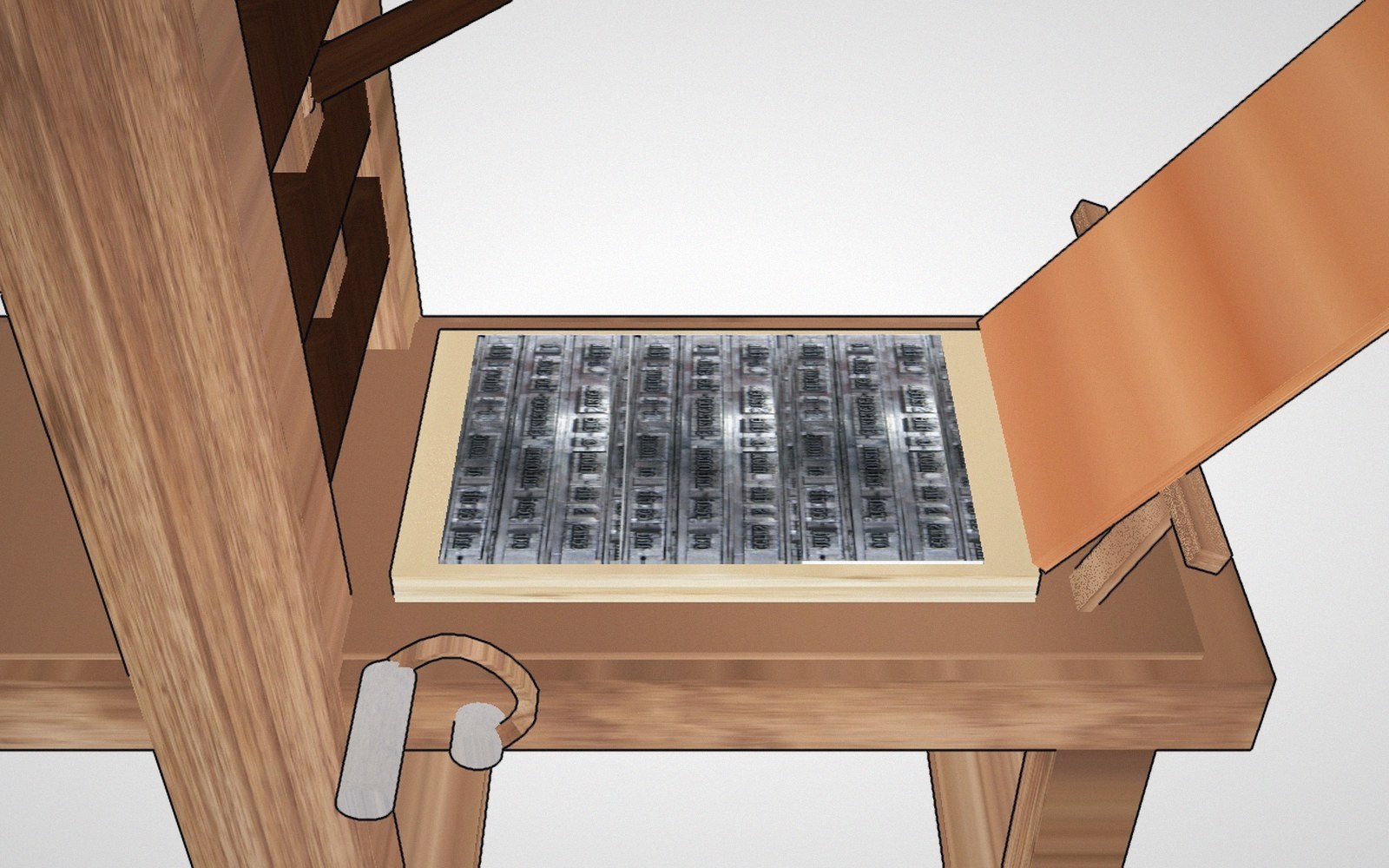
Quoins tightened against the chase: if a single sort lifts under a fingernail, the pull will pick it out.
Photo: The Printing Press. Step 2. Placing the type · Wikimedia Commons