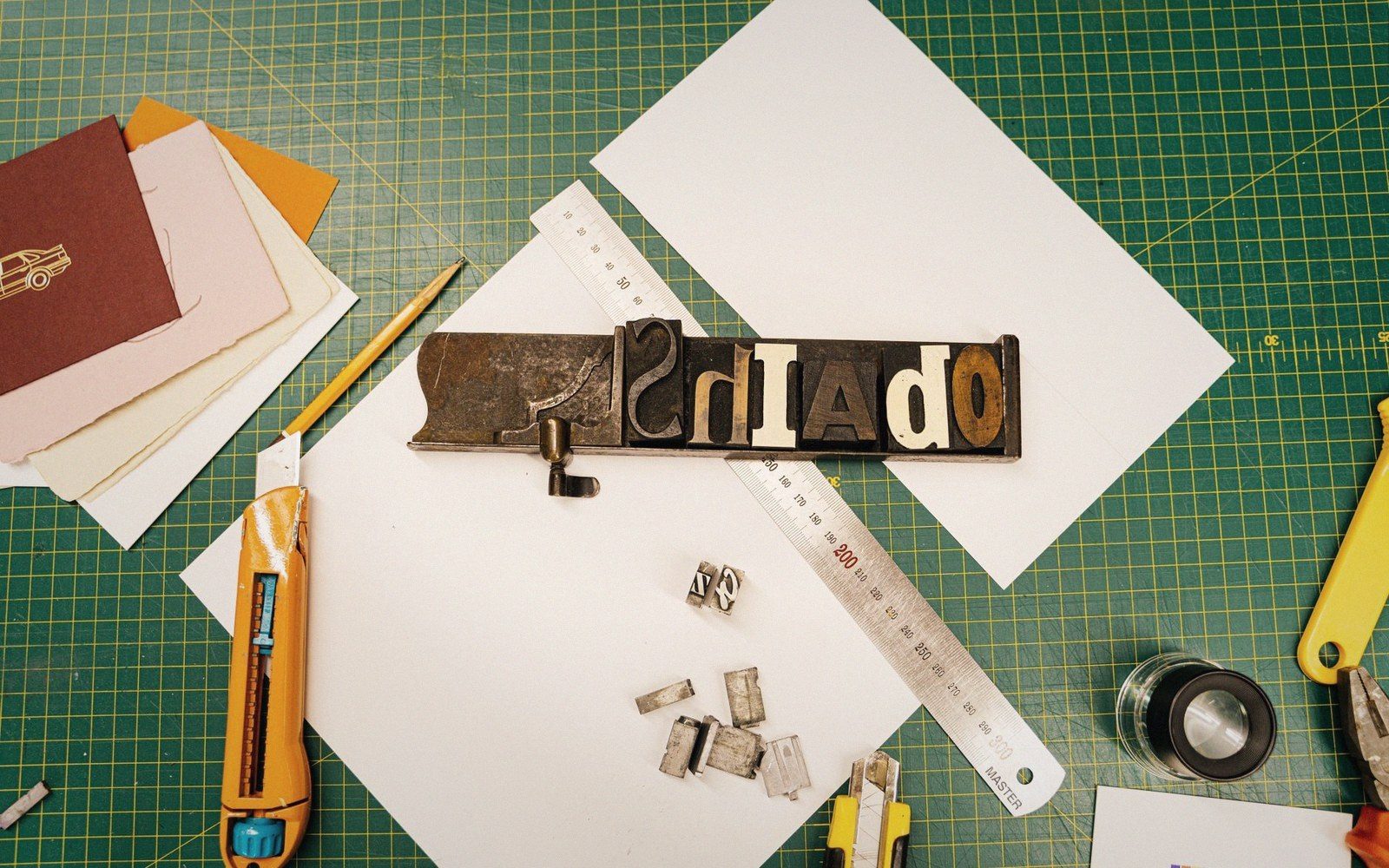
The line as the last constraint
A freshly pulled sheet cannot be stacked. The ink is wet — not damp, but genuinely wet, transferred seconds ago from the forme — and stacking it against another printed surface means offset: the ink from one sheet pressing into the back of the next, ghosting the text in reverse. Before any sheet could be counted as finished, it had to hang.
The solution in almost every classroom was a length of cord strung wall to wall, and wooden pegs — the same type that kept laundry on a line outside. A sheet went up by one corner, hung until the ink had set, came down when the next pull was ready for its place. In a small room, two or three lines might be rigged in parallel, weaving between the press, the case rack and the teacher's desk. The smell of fresh ink and the flutter of drying paper overhead became a physical fact of press days.

Wall space caps the run. A line that holds sixty sheets is a print run of sixty.
What this meant in practice was that the drying line became a hard limit on the print run. If the room could hold forty sheets hanging at once, and each sheet needed roughly half an hour to set firmly enough to handle, then the press could not simply keep pulling without the operator stopping to manage the line. In a short session, the drying time ate into the available hour more than composition or inking did. A real print run was not an abstract number chosen for ambition — it was often the number the room could hang before the first sheets were dry enough to take down.
Some schools found workarounds. Thinner ink films dried faster but sacrificed density; setting the press in a warm room near a radiator helped; printing on more absorbent stock accelerated the set. But the cord-and-peg system was never engineered away entirely — it was cheap, immediate and required nothing a classroom did not already have.
There is something telling in it. The newspaper was real: it had a press, a masthead, a defined edition. And its production was genuinely governed by physical law — the time it takes a film of ink to oxidize and bond — rather than by syllabus or timetable. No teacher could hurry the drying much. The line was full, or it was not, and the run was done when the last peg was taken.